Introduction

I led the redesign of a customer service experience for Prime support agents as part of a broader effort to move from a legacy internal tool to a more modern platform. The goal was to simplify how agents handle Prime membership issues by bringing the most important information and actions into one clearer, easier-to-use interface.

My role: Lead product designer
Timeline: 5 months, 2024
Collaborated with: Product, Engineering, Customer Support and UX research
Platform: Desktop

Understanding the Problem

The legacy experience made even common support tasks harder than they needed to be. Information was spread across multiple pages, the system relied on internal language that was hard to understand, and the overall experience was inconsistent. As a result, agents needed roughly 1,000 customer contacts, or about three months, to become proficient.

Research

To better understand the problem space, I mapped the full Prime membership lifecycle from sign-up to cancellation. This helped identify how many different states and edge cases agents need to reason about during a single customer interaction.

This exercise revealed that:

  • Agents must interpret multiple membership states (trial, active, renewal, cancellation) in real time
  • Each state introduces different rules, policies, and possible actions
  • Even simple questions often require navigating across multiple scenarios and timelines

This complexity reinforced that the problem wasn’t just navigation, it was decision-making under uncertainty.

Ideation

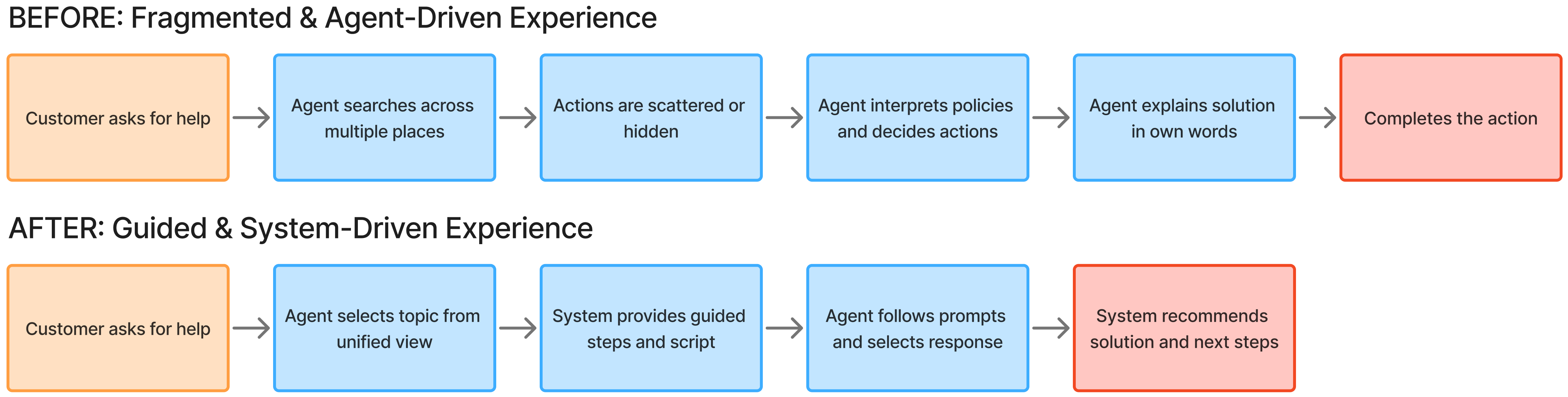
I explored multiple directions to reduce complexity for agents, including simplifying navigation, consolidating pages, and improving information hierarchy. While these helped, they didn’t fully address the core issue: agents still had to interpret policies and decide what to do next.

This led to a shift from “better navigation” to “guided decision-making.” I introduced a step-by-step support experience where agents follow clear prompts during customer interactions. The system adapts based on customer responses and surfaces the right actions in real time, removing guesswork and reducing reliance on training.

In parallel, I helped define a new design system to ensure consistency and clarity across the platform. I led the Prime membership flows and partnered with other teams to align on a unified support experience across different use cases.

Hypothesis

If we guide agents through structured, step-by-step workflows and surface the right actions based on customer responses, we can eliminate the need for heavy training, reduce decision-making friction, and enable faster, more consistent issue resolution.

Success Metrics

Primary Metric

  • Reduce time to proficiency for new agents (from months to near-zero guided onboarding)

Secondary Metrics

  • Improve resolution time for common Prime support scenarios
  • Increase first-contact resolution rate
  • Reduce reliance on training and external documentation
  • Improve consistency and accuracy of agent responses

Guardrail Metrics

  • Maintain or improve customer satisfaction (CSAT)
  • Avoid increase in average handle time (AHT) for complex cases
  • Ensure no increase in escalation rates
  • Maintain compliance with policies and refund accuracy

From Fragmented to Unified Experience

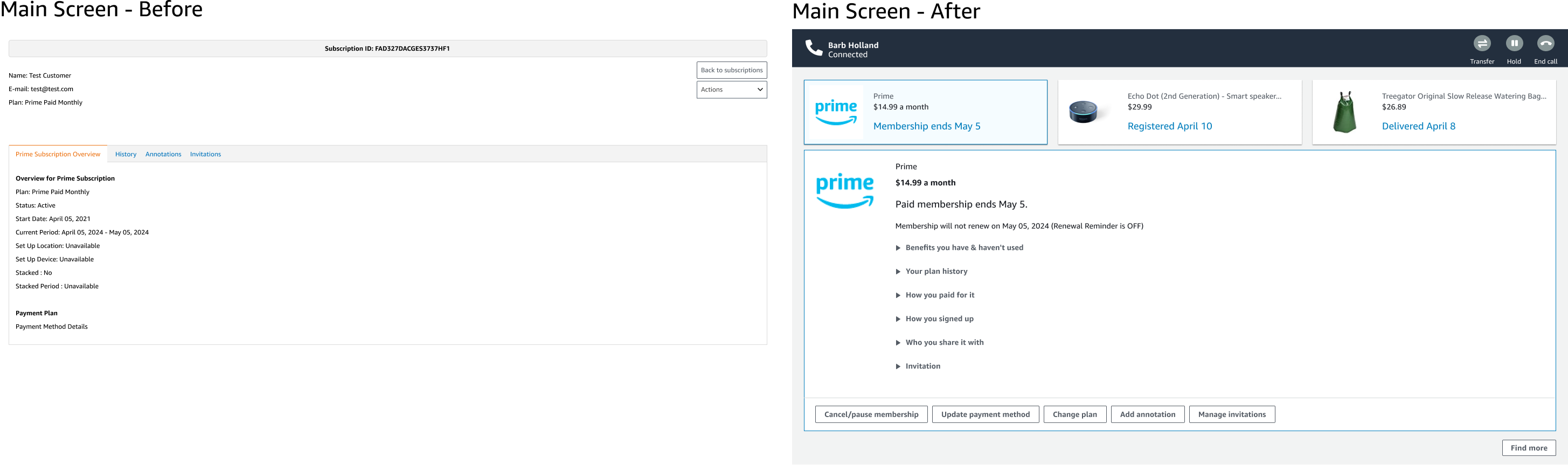
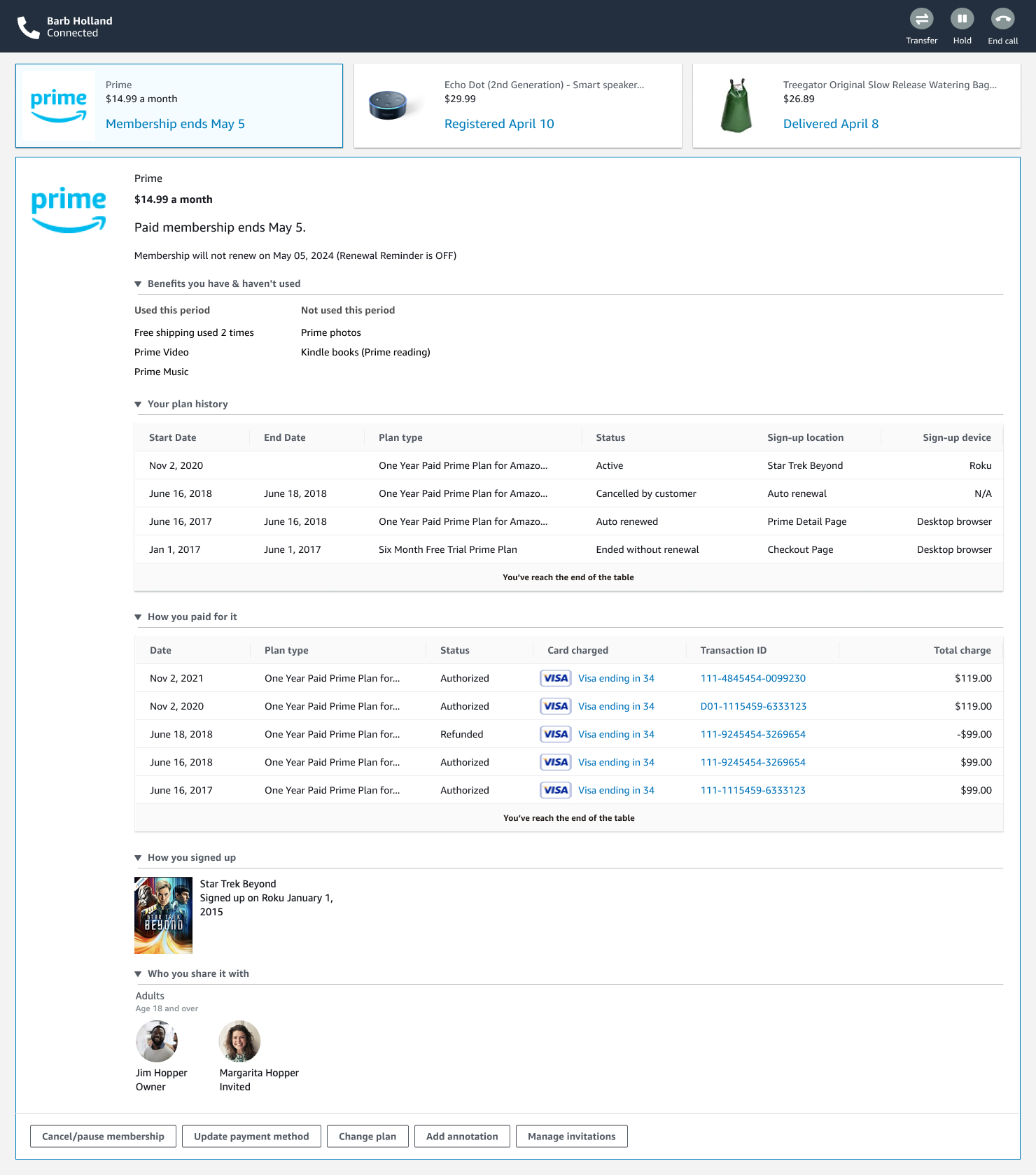
I redesigned the main support experience to make it easier for agents to quickly understand a customer’s situation and take action. The new layout surfaces critical information upfront and streamlines common workflows into a single, intuitive view.

  • Brought key membership details upfront for faster understanding
  • Consolidated information and actions into a single view
  • Improved visual hierarchy and scanability
  • Standardized patterns through cross-team collaboration

From Manual Decisions to Guided Workflows

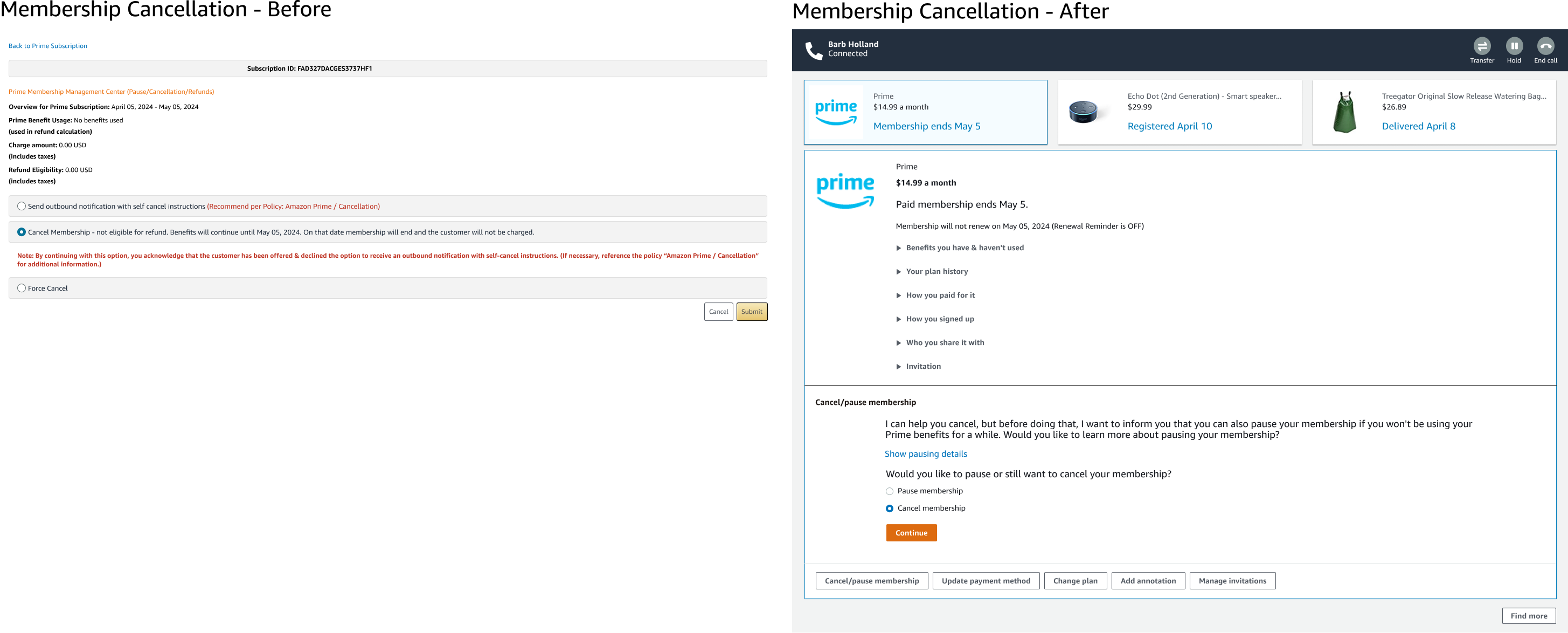
I redesigned the support workflow to guide agents through different customer scenarios without requiring them to interpret policies or rely on memory. Agents can now handle requests directly within the same view with clear, step-by-step guidance and ready-to-use scripts.

  • Kept key customer information and actions visible in one place
  • Replaced manual decision-making with step-by-step guided prompts
  • Introduced scripts for consistent and accurate communication

Usability Testing

Testing with 20 customer service agents (both new and experienced) showed:

  • Easy to follow guided workflows
  • Clear understanding of next steps and available actions
  • Improved confidence in handling customer scenarios
  • Positive response to on-screen scripts for communication

Average usability score: 4.8/5

Results

The new guided experience significantly improved how agents learn and handle customer support scenarios by reducing complexity and standardizing workflows.

Primary Metric

Reduced time to proficiency from months to near-zero through guided onboarding

Secondary Metrics

Faster resolutions, higher first-contact success, and reduced reliance on training through guided workflows

Guardrails

Maintained customer satisfaction, stable handle time, and consistent compliance without increasing escalations

Learnings and Impact

This project reinforced that the biggest impact comes from simplifying decision-making, not just the interface. By working closely with agents, I learned how much hidden complexity exists in real workflows and how guiding users step by step can significantly reduce cognitive load and training needs. It also highlighted the importance of consistent design patterns across teams to create a scalable and intuitive experience.